
Zombie Cafe 1130 Apk Android (2027)
State of the art timing analysis
with industry-hardened methods and tools.
State of the art timing analysis
with industry-hardened methods and tools.
...with industry-hardened methods and tools. T1 empowers and enables. T1 is the most frequently deployed timing tool in the automotive industry , being used for many years in hundreds of mass-production projects.
As a worldwide premiere, the ISO 26262 ASIL‑D certified T1-TARGET-SW allows safe instrumentation based timing analysis and timing supervision. In the car. In mass-production.
T1.timing comes with two extension options. Add-on product T1.streaming provides the possibility to stream trace data continuously — over seconds, minutes, hours or even days. Add-on product T1.posix supports POSIX operating systems such as Linux or QNX.
T1.timing comes with a modular concept and several plug-ins which are described in the following. Plug-ins can be easily enabled or disabled at compile-time using dedicated compiler switches such as T1_DISABLE_T1_CONT. To disable T1 altogether, it is sufficient to disable compiler switch T1_ENABLE which leaves the system in a state as of before the T1 integration.
Conclusion Zombie Cafe exemplifies a creative melding of management gameplay, collectible progression, and dark humor. While the core design offers addictive loops and accessible fun, the circulation of APKs labeled with version tags like “1130” underscores tensions between player modification, security, and developer rights. Players should prioritize official distribution channels and cautious practices to protect devices and support creators, while developers must balance monetization and community needs to keep such niche games thriving.
Cultural Impact and Themes Zombie Cafe’s premise—serving customers with undead staff—echoes broader cultural trends that sanitize horror into whimsical entertainment. It raises subtle ethical and comedic questions about labor, exploitation, and the commodification of the grotesque. As a cultural artifact, the game shows how mobile design reshapes genre conventions, turning zombies from existential threats into service-industry caricatures.
Community and Modding A passionate player base often develops around such niche mobile games. Communities share strategies, customize experiences, and sometimes create unofficial mods or APKs. These modified APKs (e.g., a file labeled “1130”) can include hacked resources, unlocked content, or bug fixes not present in the official release. While mods can extend a game’s lifespan and creativity, they also fracture the player base and undermine developers’ monetization.
Aesthetic and Tone The game’s visual style mixes cutesy character design with macabre content: adorable, stylized zombies work behind the counter, while the narrative frames their condition with tongue-in-cheek humor. This contrast softens potentially disturbing themes and broadens the game’s audience. Sound design and bite-sized writing contribute to an offbeat, campy atmosphere that keeps gameplay playful rather than grim.
Game Design and Mechanics Zombie Cafe combines two core gameplay loops: café management and zombie missions. In the café loop, players prepare and serve food and drinks to human customers. Meals are prepared by cooking stations and staffed by zombies, whose efficiency improves with upgrades. Managing orders, time-sensitive tasks, and limited resources fosters a satisfying planning challenge typical of time-management games. The mission loop sends zombies out to raid rival businesses or scavenge resources; these excursions add a light combat and progression layer, rewarding players with ingredients, currency, or rare items. Progression systems—leveling, zombie classes, equipment, and café décor—create long-term goals and a sense of growth.
Zombie Cafe is a mobile game franchise that blends strategy, time management, and dark humor by placing players in charge of a café staffed by reanimated undead. Players manage resources, expand their menu, and send zombies on missions while balancing customer satisfaction and combat. The phrase “Zombie Cafe 1130 APK Android” likely refers to an Android application package (APK) version identified by number 1130—either a specific build, update, or an unofficial distribution. This essay examines the game’s design, appeal, community, and the considerations around APK distribution, particularly focusing on security, legality, and player experience.
For POSIX-based projects, see T1.posix.
Conclusion Zombie Cafe exemplifies a creative melding of management gameplay, collectible progression, and dark humor. While the core design offers addictive loops and accessible fun, the circulation of APKs labeled with version tags like “1130” underscores tensions between player modification, security, and developer rights. Players should prioritize official distribution channels and cautious practices to protect devices and support creators, while developers must balance monetization and community needs to keep such niche games thriving.
Cultural Impact and Themes Zombie Cafe’s premise—serving customers with undead staff—echoes broader cultural trends that sanitize horror into whimsical entertainment. It raises subtle ethical and comedic questions about labor, exploitation, and the commodification of the grotesque. As a cultural artifact, the game shows how mobile design reshapes genre conventions, turning zombies from existential threats into service-industry caricatures. zombie cafe 1130 apk android
Community and Modding A passionate player base often develops around such niche mobile games. Communities share strategies, customize experiences, and sometimes create unofficial mods or APKs. These modified APKs (e.g., a file labeled “1130”) can include hacked resources, unlocked content, or bug fixes not present in the official release. While mods can extend a game’s lifespan and creativity, they also fracture the player base and undermine developers’ monetization. Conclusion Zombie Cafe exemplifies a creative melding of
Aesthetic and Tone The game’s visual style mixes cutesy character design with macabre content: adorable, stylized zombies work behind the counter, while the narrative frames their condition with tongue-in-cheek humor. This contrast softens potentially disturbing themes and broadens the game’s audience. Sound design and bite-sized writing contribute to an offbeat, campy atmosphere that keeps gameplay playful rather than grim. Community and Modding A passionate player base often
Game Design and Mechanics Zombie Cafe combines two core gameplay loops: café management and zombie missions. In the café loop, players prepare and serve food and drinks to human customers. Meals are prepared by cooking stations and staffed by zombies, whose efficiency improves with upgrades. Managing orders, time-sensitive tasks, and limited resources fosters a satisfying planning challenge typical of time-management games. The mission loop sends zombies out to raid rival businesses or scavenge resources; these excursions add a light combat and progression layer, rewarding players with ingredients, currency, or rare items. Progression systems—leveling, zombie classes, equipment, and café décor—create long-term goals and a sense of growth.
Zombie Cafe is a mobile game franchise that blends strategy, time management, and dark humor by placing players in charge of a café staffed by reanimated undead. Players manage resources, expand their menu, and send zombies on missions while balancing customer satisfaction and combat. The phrase “Zombie Cafe 1130 APK Android” likely refers to an Android application package (APK) version identified by number 1130—either a specific build, update, or an unofficial distribution. This essay examines the game’s design, appeal, community, and the considerations around APK distribution, particularly focusing on security, legality, and player experience.
| Vendor | Operating System |
|---|---|
| Customer | Any in-house OS** |
| Customer | No OS - scheduling loop plus interrupts** |
| Elektrobit | EB tresos AutoCore OS |
| Elektrobit | EB tresos Safety OS |
| ETAS | RTA-OS |
| GLIWA | gliwOS |
| HighTec | PXROS-HR |
| Hyundai AutoEver | Mobilgene |
| KPIT Cummins | KPIT** |
| Siemens | Capital VSTAR OS |
| Micriμm | μC/OS-II** |
| Vector | MICROSAR-OS |
| Amazon Web Services | FreeRTOS** |
| WITTENSTEIN high integrity systems | SafeRTOS** |
| Qorix | Qorix Classic |
| Embedded Office | Flexible Safety RTOS |
(**) T1 OS adaptation package T1-ADAPT-OS required.
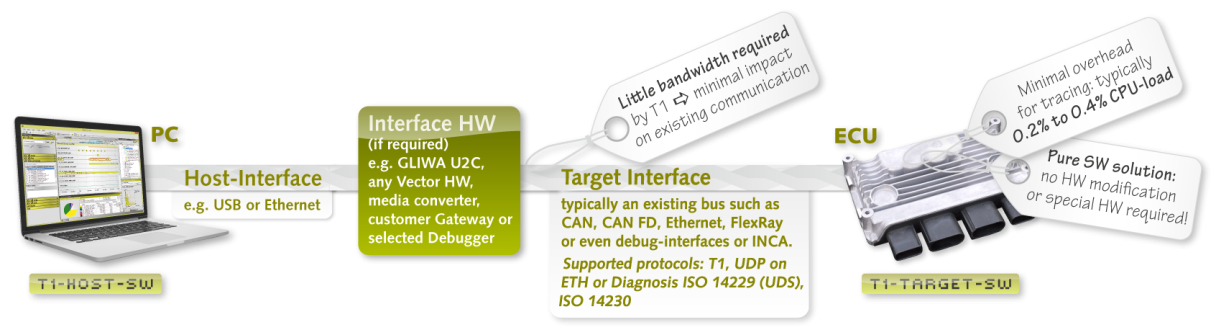
| Target Interface | Comment |
|---|---|
| CAN | Low bandwidth requirement: typically one CAN message every 1 to 10ms. The bandwidth consumed by T1 is scalable and strictly deterministic. |
| CAN FD | Low bandwidth requirement: typically one CAN message every 1 to 10ms. The bandwidth consumed by T1 is scalable and strictly deterministic. |
| Diagnostic Interface | The diagnostic interface supports ISO14229 (UDS) as well as ISO14230, both via CAN with transportation protocol ISO15765-2 (addressing modes 'normal' and 'extended'). The T1-HOST-SW connects to the Diagnostic Interface using CAN. |
| Ethernet (IP:TCP, UDP) | TCP and UDP can be used, IP-address and port can be configured. |
| FlexRay | FlexRay is supported via the diagnostic interface and a CAN bridge. |
| Serial Line | Serial communication (e.g. RS232) is often used if no other communication interfaces are present. On the PC side, an USB-to-serial adapter is necessary. |
| JTAG/DAP | Interfaces exist to well-known debug environments such as Lauterbach TRACE32, iSYSTEM winIDEA and PLS UDE. The T1 JTAG interface requires an external debugger to be connected and, for data transfer, the target is halted. TriCore processors use DAP instead of JTAG. |
